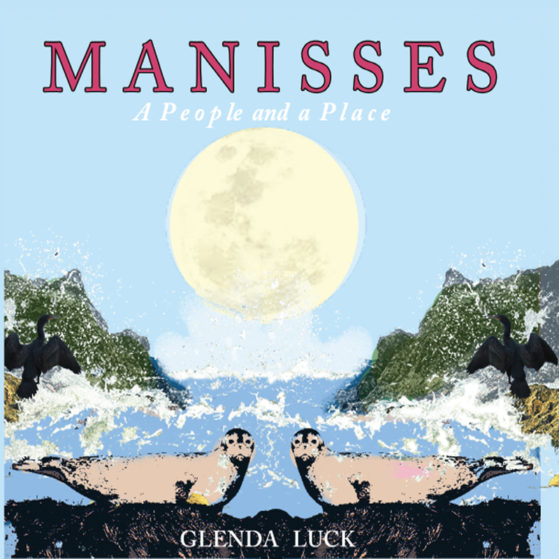
Manisses: A people and A Place
A Musical Odyssey through Block Island’s Native American History
Since her first visit in 1995, Glenda Luck has been in love with Block Island, living there on and off throughout her life, walking its land and coming to know its people and history intimately. In 2011 she learned that the history and culture of the island’s indigenous people, the Manisses, was not part of the Rhode Island state public school curriculum. That discovery became the seed of this album.
Written out of deep admiration and respect for the first people of Block Island, Manisses: A People and A Place is a full-length folk music narrative weaving original compositions with historical narratives, archival texts, and the voices of indigenous community members, archaeologists, genealogists, and naturalists. All songs were written from the perspective of the songwriter and make no other representations.
“To ignore the indigenous peoples history and culture of this country — or any people’s history and culture of any place, is to erase their identity, their entire existence. It is an act of genocide. This is something my soul cannot bear. The time for this to change is now.” — Glenda Luck
This project was created out of respect for all who came before, all who are here now, and all who come after.
Select works from this album have been used by descendants of the Manisses people for doctoral research and as part of a traveling indigenous educational series. Glenda was invited to perform at the Tomaquag Museum Honoring Dinner (2014) by Executive Director Loren Spears (Narragansett).
Glenda Luck is the recipient of the 2013 Fellowship in Music Composition awarded by the Rhode Island State Council on the Arts, in part for several compositions associated with this album.
BIBLIOGRAPHY
Books
Bellantoni, Nicholas F. Faunal Resource Availability and Prehistoric Cultural Selection on Block Island, Rhode island. PhD Diss. University of Connecticut, 1987. Ann Arbor: UMI, 2000. Print.
Niles, Samuel. Niles History of the Indian and French Wars (p196-197) re: silver paddles
Massachusetts Historical Society., . Collections. Ser. 3, v. 6 (1837). Boston: Massachusetts Historical Society.
Livermore, S.T. Livermore’s History of Block Island Rhode Island. Forge Village, Massachusetts: The Murray Printing Company, 1877,1961. Print.
McBride, Kevin A. “Fort Island: Conflict and Trade in Long Island Sound.” Native Forts of the Long Island Sound Area. Ed. Gaynell Stone. Stony Brook, NY: Suffolk County Archaeological Association/Nassau County Archaeological Committee, 2006. 255-266. Print.
Reiser, Christine N. “Safeguarding the ‘Mint’: Wampum Production and the Social Uses of Space at Fort Island.” Native Forts of the Long Island Sound Area. Ed. Gaynell Stone. Stony Brook, NY: Suffolk County Archaeological Association/Nassau County Archaeological Committee, 2006. Print.
Williams, Roger. What Cheer, Netop!: Selections from A Key Into the Language of America. Providence, RI: Haffenreffer Museum of Anthropology, Brown Univ.,1986. Print.
Howe, Jeffrey. The History and Genealogy of Descendants of Slaves and Indians from the Island of “Manissee” Block Island. Riverside, RI: Jeffrey Howe, 1997. Print.
Downie, Robert M. Block Island – The Land. Block Island, RI: Book Nook Press, 2001. Print.
Gardiner, Curtiss C. The Papers and Biography of Lion Gardner. St. Louis: Press of Levison & Blythe Stationery Co., 1883. Web. 2012.
Underhill, John and Royster, Paul, editor, “Newes from America; Or, A New and Experimentall Discoverie of New England; Containing, A Trve Relation of Their War-like Proceedings These Two Yeares Last Past, with a Figure of the Indian Fort, or Palizado” (1638). Electronic Texts in American Studies. Paper 37.
http://digitalcommons.unl.edu/etas/37
Journals
Nixon, Scott. “Marine Resources and the Human Carrying Capacity of Coastal Ecosystems in Southern New England Before European Contact.” Northeast Anthropology 68 (2004): 1. Print.
The Ecology of Block Island Proceedings of the Rhode Island Natural History Survey Conference October 28, 2000. Ed. Peter W. Paton, Lisa L. Gould, Peter V. August, Alexander O. Frost. Kingston, RI: The Rhode Island Natural History Survey, 2002. Print.
Interviews
Comings, Scott. Personal interview with the author. 2012.
Dubois, Coni. Personal interview with the author. 2012-2013.
Ives, Goddard. “RE: A question re: Rhode Island Place Names.” Message to Glenda Luck. October 12, 2011. E-mail.
McBride, Kevin. Series of Personal interviews with the author. 2011-2013.
Spears, Lorén. Personal interviews with the author. 2011-2013.
Films
500 Nations. Dir. Jack Leustig. Writ. Jack Leustig, Roberta A Grossman, Lee Miller, W.T. Morgan, Dr. John M.D. Pohl. Head of Research, Lee Miller. Prod. Roberta Grossman, Jim Wilson, Kevin Costner, Jack Leustig. TIG Productions, RCS Films & T.V., Magestic Films, Television International, 1995.
American Experience: We Shall Remain. Dir. Chris Eyre, Ric Burns,Stanley Nelson Jr., Dustinn Craig, Sarah Colt. Writ. Dustinn Craig, Sarah Colt, Ric Burns, Mark Zwonitzer, Marcia Smith, Anne Makepeace, Sharon Grimberg. Prod. Stanley Nelson, Ric Burns, Mark Zwonitzer, Rob Rapley, Dustinn Craig, Sarah Colt. PBS Home Video, 2009. DVD.